by ABBY LUONG
Traditionally, on the first day of the Lunar New Year, those who celebrate the holiday gather with family to wish each other luck, fortune and happiness. This year’s celebration was the first to be recognized by the state of California as an official state holiday.
On the eve of this Lunar New Year, 72-year-old gunman Huu Can Tran murdered 11 people in a mass shooting in Monterey Park, plunging the Asian-American community into a state of terror and anguish.
An ethnocultural community of many Asian immigrants, Monterey Park is a city of almost 60,000 residents in the San Gabriel Valley, about 10 miles east of Downtown L.A. It hosts an annual Lunar New Year festival that is considered one of the biggest in Southern California. The festival rings in the new year with traditional Chinese lion dances, booths with holiday and street food, and interactive cultural activities such as wishing trees, as well as carnival games.
While the two-day celebration went on as usual during the day on Saturday, Jan. 21, the community was rocked by a mass shooting later that night. Around 10:20 p.m., the sole assailant, Tran, opened fire on a ballroom dance studio, just steps away from the festival that had closed a few hours earlier. Inside the studio, the dancers, mostly older Chinese and Vietnamese men and women, were participating in a ballroom-dance Lunar New Year event.
Ten people died at the scene, and one more victim passed away in the hospital on Monday. The victims were Xiujuan Yu, 57; Hongying Jian, 62; Lilan Li, 63; Mymy Nhan, 65; Muoi Dai Ung, 67; Diana Man Ling Tom, 70; Wen-Tau Yu, 64; Valentino Marcos Alvero, 68; Ming Wei Ma, 72; Yu-Lun Kao, 72, and Chia Ling Yau, 76.
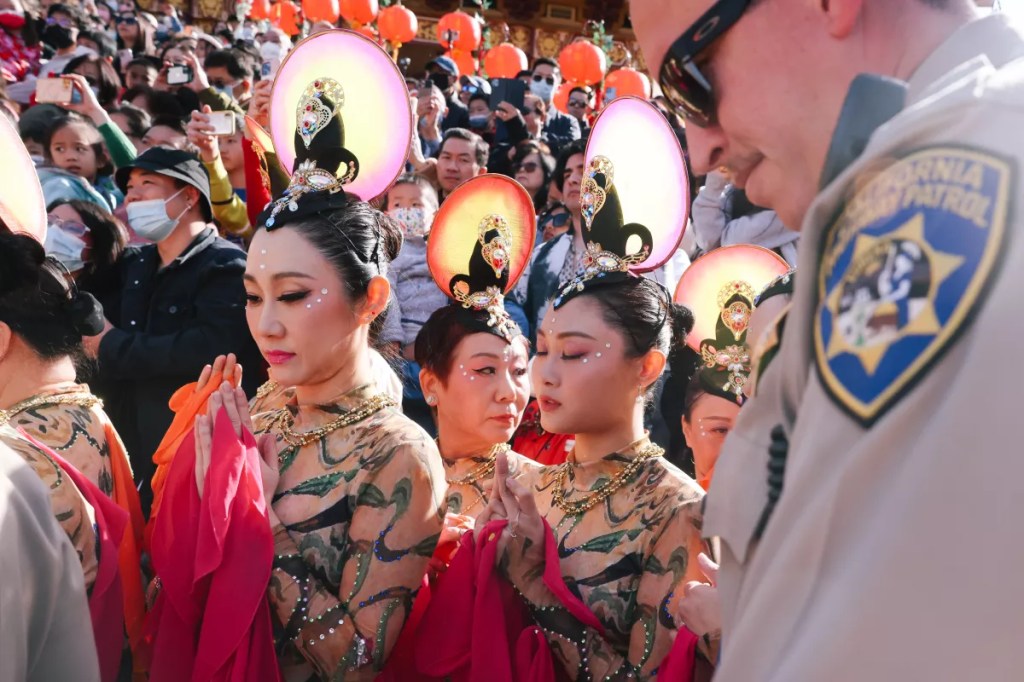
Lunar New Year, normally a joyous occasion for Asian communities around the world, was marred this year by a mass shooting in Monterey Park. / LOS ANGELES TIMES
Shortly after the shootings, witnesses at another dance hall, Lai Lai Ballroom & Studio, in the nearby city of Alhambra, reported a sighting of a similarly described gunman.
The third-generation owner of the studio, Brandon Tsay, reported to CNN that he had seen Tran entering the lobby with a gun and reacted. Tsay physically struggled with Tran, as seen in a security video released by NBC, and managed to disarm him.
Tsay has been hailed as a hero; he was honored by the city at the Alhambra Lunar New Year Festival, and Rep. Judy Chu chose him to be her guest at last week’s State of the Union address in Washington.
The next morning, Sunday at about 10:20 a.m., SWAT teams in Torrance surrounded a van parked at the Tokyo Central strip mall, at the corner of Hawthorne and Sepulveda boulevards, approximately four miles from Chadwick.
While the police are still unsure of Tran’s motive, it has been noted that the gunman was an avid ballroom dancer who once frequented both establishments. In interviews with Tran’s ex-wife and former friends, many remarked that he had a quick temper and trust issues, indications of mental instability.
The next day, Monday, 66-year-old Chunli Zhao, a Chinese national, traveled to two mushroom farms in the Northern California coastal city of Half Moon Bay, approximately 30 miles south of San Francisco, and shot and killed seven people.
The victims were Yetao Bing, 43; Qizhong Cheng, 66; Marciano Martinez Jimenez, 50; Aixiang Zhang, 74; Jingzhi Lu, 64, and Zhishen Liu, 73.
Chadwick’s Asian American Student Assn. held a space that week for Middle and Upper School students of Asian descent to process the violence.
“Chinese New Year is supposed to be a time of celebration, love, prosperity and family, and that was taken from us,” said senior AASA co-leader Anna Gu, who has strong feelings about gun-control policy.
“We need to urge legislators in California to further strengthen our gun-control policies. If we want stricter gun control, the NRA needs to have less influence on bureaucrats,” Gu said.
 The Mainsheet